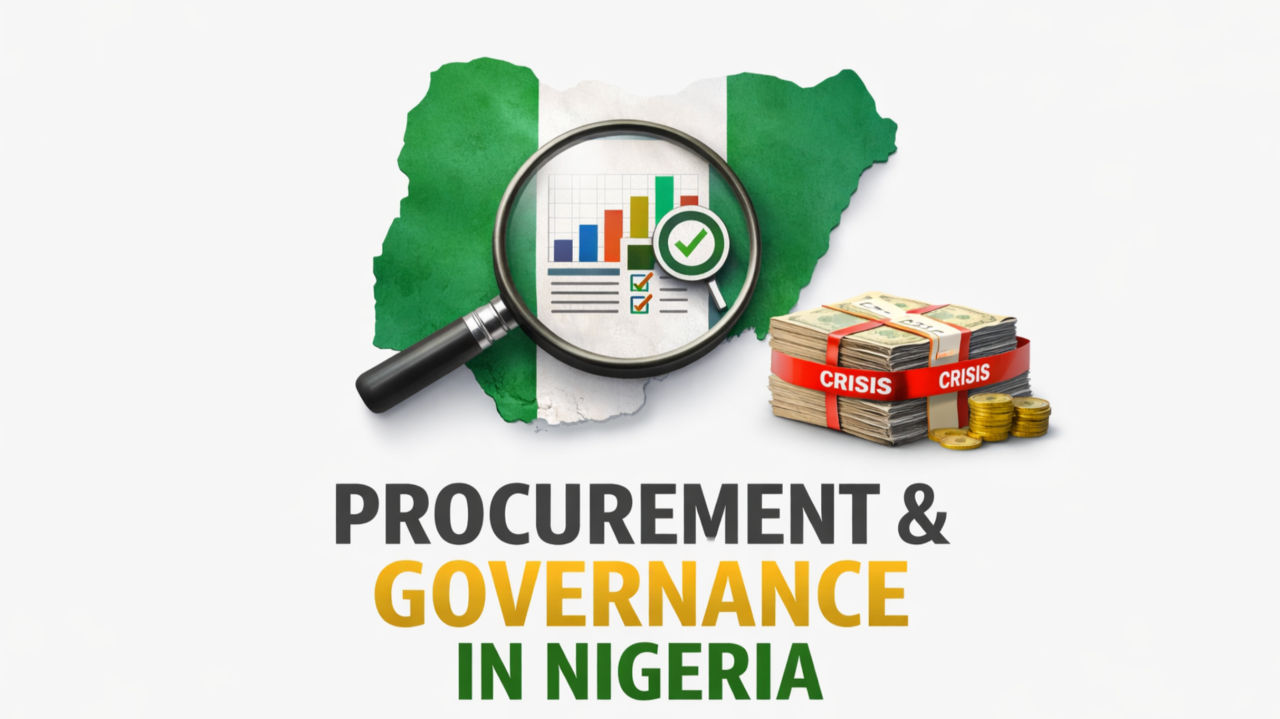
For a long time, procurement was treated as an internal process issue — something administrative, transactional, and mostly invisible unless something went wrong. But that is changing fast. In Nigeria, procurement is increasingly becoming a test of governance, financial discipline, and institutional credibility. The recent pattern is hard to ignore: when procurement is poorly tracked, weakly documented, or rushed under pressure, it quickly stops being a procurement issue and becomes a public issue.
One of the clearest examples came this month when lawmakers began probing allegations around the procurement of 101 POS machines for about ₦97 million by the National Commission for Persons with Disabilities. Regardless of where the investigation ultimately lands, the bigger lesson is already visible. If an organisation cannot clearly show how a price was justified, who approved the spend, what benchmark was used, and why a supplier was selected, then procurement becomes vulnerable to doubt, scrutiny, and reputational damage. (Premium Times Nigeria)
A second signal came from the power sector, where the Nigeria Labour Congress alleged a ₦20 billion emergency procurement scandal involving the Transmission Company of Nigeria and called for a forensic audit. This matters because emergency procurement is often where control breaks down fastest. Speed becomes the excuse for bypassing structure. Documentation gets thinner. Approvals get compressed. Competitive checks weaken. And once that happens, organisations are left trying to explain decisions after the fact instead of controlling them in real time. (Punch Newspapers)
What is striking is that these stories are unfolding at the same time Nigeria is pushing more aggressively toward digital procurement reform. The Bureau of Public Procurement has said that contractors bidding for public projects must now submit bids electronically from March 2, 2026 as part of a broader move to improve transparency and accountability. That is an important shift. It suggests the market is moving away from procurement as a paper trail and toward procurement as a traceable digital system. (Businessday NG)
And the reform discussion is not stopping at tender submission. The BPP has also introduced a community-based procurement framework to track constituency projects, signalling that visibility is now expected not just at the point of bid submission, but also during project execution and delivery. That is where many organisations still underestimate their exposure. Procurement failure does not only happen at the sourcing stage. It also happens in the space between award and delivery, between invoice and payment, and between contract signature and actual execution. (Businessday NG)
That is why procurement software should no longer be framed simply as a tool for efficiency. In this environment, it is increasingly a tool for defensibility. The real value is not just automating requests or generating purchase orders. The real value is creating a system where every decision can be explained: why this vendor, why this amount, why this approval path, why this exception, and what happened after the award. The organisations that will be safest in the years ahead will not just be the ones that buy faster. They will be the ones that can prove, at any point, that they bought responsibly. This is the deeper message behind the current wave of procurement scrutiny in Nigeria.
This is also why the strongest opportunity for procurement technology in Nigeria is not just digitisation for its own sake. It is control. It is visibility. It is procurement-finance alignment. It is the ability to prevent inflated buying, flag unusual spend patterns, make emergency procurement defensible, connect commitments to budgets, and track awarded work to completion. In a market where oversight is rising, those are no longer “nice to have” features. They are the difference between confidence and crisis. The market is moving toward systems that make procurement observable, auditable, and harder to manipulate.
The shift is not only local. Globally, procurement is also moving into a new phase shaped by AI and decision intelligence. Reuters reported this week that Oracle is reworking its finance and procurement software around “agentic apps”, with AI handling data collection, entry, and recommendations while human teams focus more on negotiation, judgement, and supply risk decisions. That development matters because it shows where enterprise software is heading. Procurement systems are evolving from workflow tools into decision-support systems. But that also raises the stakes: if AI is going to touch invoices, purchase orders, and supplier actions, then control, explainability, and exception management become even more important. (Reuters)
The big takeaway is simple. Procurement is no longer a quiet administrative function sitting in the background of the business. It is becoming one of the clearest mirrors of how seriously an organisation takes governance, cost control, execution discipline, and trust. In Nigeria, recent events are making that visible in real time.
The institutions and companies that respond well will be the ones that stop treating procurement as paperwork and start treating it as infrastructure.
That journey begins here – www.seamlessprocure.com